Old School Mentality Gets 86'd: Part 6
A Conversation with a Local Business Owner on Where We Go From Here

I didn’t write the letter and say, “We will be doing this.” I wrote the letter and said, “We are doing this.” - Sean Fitzgerald, Owner of Allusion and The Wobbly Olive
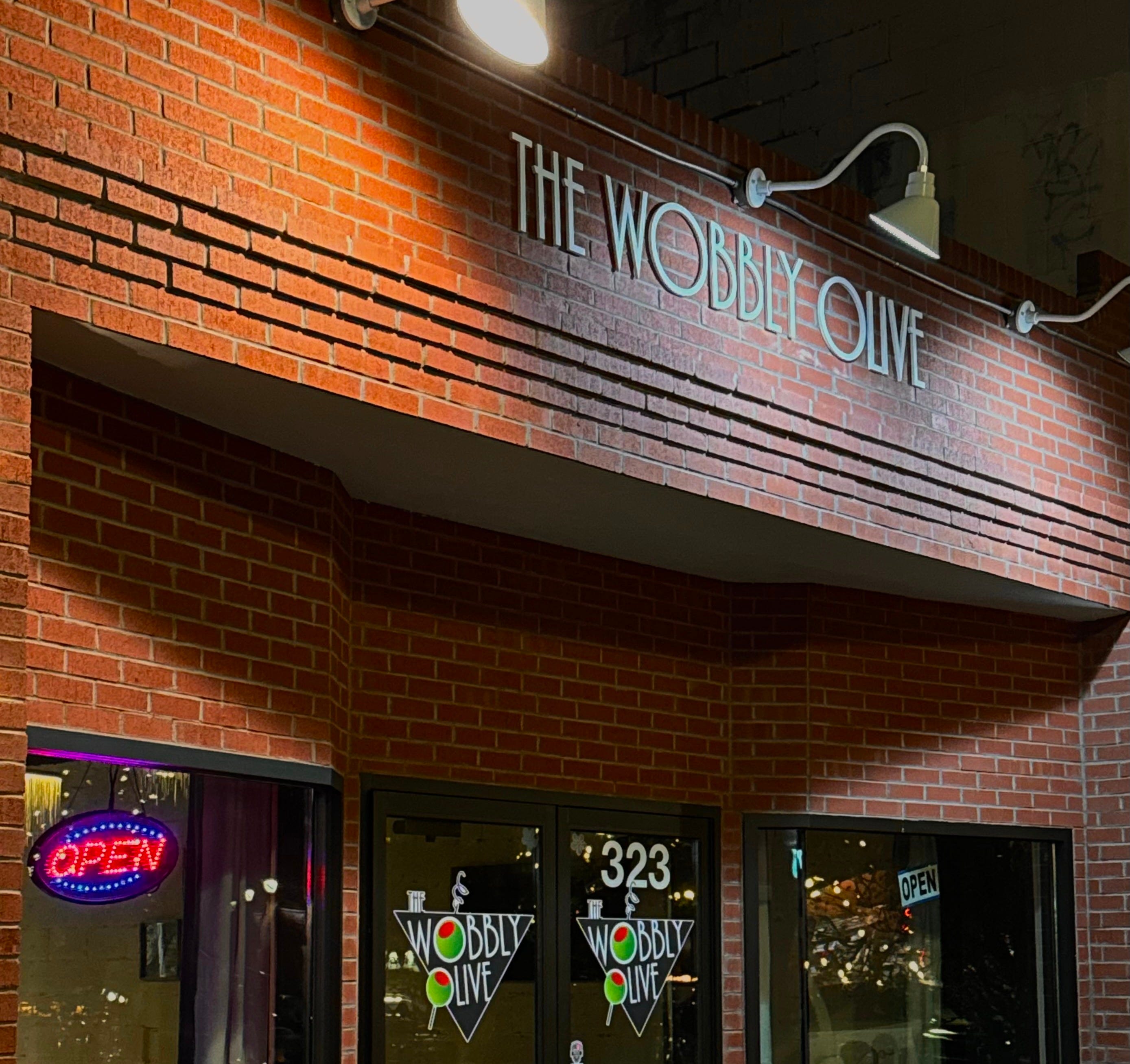
On March 29th, I was contacted by an employee of Allusion and The Wobbly Olive. The message contained a picture of a letter addressed to the entire staff at both locations. This employee mentioned that, after reading my articles and keeping tabs on “the Noma situation,” this might be something that I would be interested to see.
I implore you to read the entire letter. The weight it carries is profound enough that I felt compelled to reach out to the Owner to continue the conversation.
The letter to the staff reads as follows:
“Team,
I want to take a moment to talk openly about where we’ve been, what we’ve learned, and what we’re changing moving forward.
Over the past few weeks, we’ve had several team members move on. That put Inez and me in a position where we stepped in and worked many shifts ourselves. Being back in it every day gave us a very real, ground-level view of what you’ve all been dealing with - and there are some things we need to own.
I also want to recognize some team members who stepped up during that time. [REDACTED], specifically, took on a significant amount of extra responsibility, as well as several others picked up shifts, they weren’t originally scheduled for to help keep things running. That kind of effort does not go unnoticed, and it’s genuinely appreciated.
Things we have noticed:
First, our training process has not been where it needs to be. We’ve had situations where new hires were brought in, shown the basics, and then(because of call-offs, staffing gaps, or simple mistakes) were put on the floor or behind the bar before they were truly ready. That’s not fair to you, and it’s not fair to them. It creates stress, slows everyone down, and sets people up to feel overwhelmed instead of confident.
Second, we’ve leaned too heavily on single points of failure - especially behind the bar. There have been shifts where one bartender carried the entire workload from start to finish without real support. That’s not sustainable, and it’s not the standard we want to operate at.
Third, I want to take accountability. I was looking at things from a high level - numbers, covers, outcomes, reviews - without fully appreciating what those shifts actually felt like in real time. That’s on me. The pace, the volume, the large parties. the constant pressure - it’s different here, and I should have recognized that sooner.
I also want to address something that’s been said about our WhatsApp chat. I’ve heard the feedback that at times it has felt negative or toxic. I take responsibility for my part in that. There were moments where I came in the next morning asking questions like ‘why was the close like this???’ or ‘how did this happen???’ and ‘read this review…’ or ‘how did we not hear…’ - without fully understanding what the shift actually looked like from your perspective. Moving forward, that approach is changing.
Communication should help us improve, not add stress. We’re going to keep communication focused on solutions and support moving forward.
So here’s what we’re doing about it.
We’ve brought on a group of new team members, and more importantly, we’ve already started changing how we train. Every new hire is being trained during daytime sessions, so they walk in already understanding our cocktails, food, table numbers, POS, and standards. The goal is simple: no one should ever feel thrown into a shift unprepared again.
[. . .]
These additions are not about replacing anyone - they’re about supporting everyone.
We also recognize that the current workload has made it difficult to take time off or even consider picking up extra shifts. When you’re already working hard, back-to-back, high-volume nights, it’s unrealistic to expect people to keep stacking shifts on top of that. That’s how burnout happens, and we need to fix it.
As a result, you may see some changes in scheduling and, in some cases, adding support to much needed evenings as well as brunches. I want to be very clear about this: the goal is not to take away opportunity - it’s to create a more balanced, sustainable environment where shifts are supported, service is smoother, and everyone can perform at a higher level without feeling run down.
Because the reality is this - when we are properly staffed and supported, everything improves. Service is better, mistakes go down, guests stay longer, tip percentage is higher and sales increase. A stronger, more supported team directly benefits everyone on the floor.
To support these changes, we are also continuing to build structure into training immediately.
We will be holding a new food menu training tomorrow at 10:00 AM at WDT. We understand this is short notice, so we will also be recording the training and sharing videos for anyone who is unable to or choose not to attend.
[. . .]
These transitions are not just about a new theme; they’re an opportunity to relaunch with better systems, better training, and stronger support across the board.
I appreciate the work you’ve all been putting in, especially through a challenging stretch. I hear you, I see what’s been happening, and we’re making changes to improve it.
If you have questions, concerns, or feedback, my door is always open.
Let’s get better together.
Sincerely,
Sean Fitzgerald”
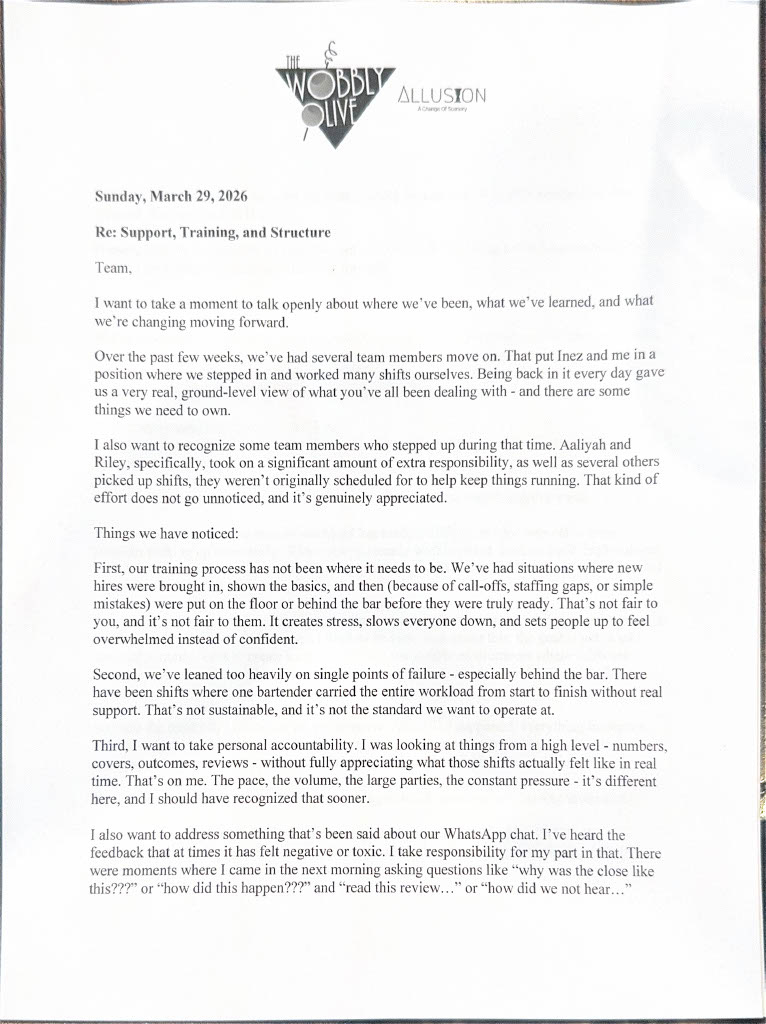
Upon reading the letter, I was immediately struck with emotion. Numerous points in the letter were things I could only wish an owner would have addressed at past jobs.
“I hear you, I see what has been happening, and we’re making changes.”
I immediately called Sean to set up a time to talk more about the letter and why he wrote it…
***The following conversation is a direct transcription of a phone call between Sean Fitzgerald and myself. Any changes made are for streamlining a much longer conversation. All other edits are marked accordingly. Questions and answers are not necessarily written in the order that they were asked.***
I didn’t think about it when I did it.. it felt like the right thing to do. Sending a mass text message out to everybody just didn’t make a huge amount of sense.
What prompted you to send the letter? Was there a specific incident?
There wasn’t a single straw that broke the camel’s back. However, I think I lost four bartenders in probably like two weeks. And me, very petulantly, I was like, “well, I’m gonna work their shifts.” Right off the bat, there were things I was seeing where it was like, okay, I have no idea why we’re doing that. There is a better way to do this. [Even on a night with low covers,] I didn’t realize how relentless it can actually be.
[On one of the nights,] one of the drains at [the restaurant] had backed up. I’m trying to help and fix it, so I have my arm all of the way down in the drain trying to figure out whatever is clogging that. We only had two other people working that night, and they came out and said, “You have a drink order.” So I say, well, just make the drink real quick. My arm is in a drain! And both of them looked me in the eyes and said that they didn’t know how to make the drink. [In that moment, it’s like,] you’ve been with me for eight months. We’ve been on [this menu] now for over 60 days. What do you mean you don’t know how to make that drink?
At this point, it was that decision of, I have two inches of standing water in the kitchen right now, but we also have a guest that is now waiting for a drink. Do I pull my arm out, wash my hands, and go make this drink? Or do I try and pull whatever clog this is out so my cooks can actually operate? The one right answer is that I needed to do a better job training my staff so that, when something happens, nobody feels unequipped.
Is that the point when you decided you needed to start making changes?
Without even a question. I started asking some of the people who had been with me for maybe 90 days, “How was your first day of training?” [And it was always] somebody had the flu, or sprained an ankle, or somebody called out. So now, instead of training them, they put them on the floor. Just baptism by fire. [. . .] That’s a lot of pressure to put on one person.
There were things I saw that I could have done better at. I’m not their boss, I’m their leader. So I fix those things, because when somebody’s feeling negative about working or being part of your team… we can always sit back and blame them, but very rarely do we ever blame ourselves. Me working those shifts was me looking in the mirror.
So, you send out the letter. How did your staff respond?
Many of the comments were actually ones that were disheartening for me, which is, “Well, I thought that’s just how we did things.” And that doesn’t make sense, but I don’t think that there was an open line of communication on things that were struggling. I also think that we diminished when somebody did have a problem. So, when people come forward and said, “that’s just how we do things,” I think we shouldn’t have to.
We’re a small, locally-owned business. I can do whatever the fuck I want! If I want to train more people, let’s train more people. If there’s a problem that I don’t know about, if there’s a stress point, let’s talk about it.
And the response has been, I think, very positive, [because] quite frankly, I had lost a lot of their trust.
Do you think that this letter is a good step towards rebuilding that trust?
Yes. Because I own the place, I didn’t write the letter and say, “We will be doing this.” I wrote the letter and said, “We are doing this.” [. . .] So, long story short, by actually getting back there and working, and not just saying it… Like, I’m not gonna make a TikTok saying, “look at me on the line doing prep!” I never posted a single thing [. . .] I actually worked all of the shifts, open to close. I didn’t just pop in, take my suit jacket off, put a chef coat on, and then cook a few things to make a video. None of this was for content.
So… What changes have you made?
They needed a lot more help with training. [. . .] And they needed more support. So I hired 12 people. And then, I started doing trainings during the day(when the restaurants are closed) so that, when a new person shows up [. . .] they’ve already made every single cocktail on the menu. [. . .] They know the table numbers. They know how to use the POS. [. . .] They’ve already done mock services with me. They know 75% of the job and they are bartenders.
We did an entire day of just POS training, just how to ring things up. I actually had Chef [Mark Henry] here. And so, they were ringing food up and then he would come back and say, “This is a better way of doing this” or “This is how I want my tickets to come in.” [. . .] He could critique from the kitchen perspective. This helps me.
We have front of house and back of house, but we’re still just one house. It’s hitting the relief valve, to give [the staff] an opportunity. One where, I can show you, you will earn more money, with less stress, and with support.
Because we’re changing concepts and themes so much, so abruptly… It’s almost like opening two new restaurants every 90 days, so the way we get relief from that is by having training be the biggest part.
But also, the way I support. I waited until they were done with training to send a letter. So it wasn’t, this is what we plan to do. This is what we have done.
You read the articles that I’ve posted on this sort of “restaurant reckoning” situation so far. What were your first impressions of all the discussion happening around abuse and exploitation in kitchens?
I’m a very weird person to ask that question, because I opened a restaurant before I’d ever even waited a table or worked in the kitchen. So, from my perspective, I never went into it with, “Well, this is how we do it.” The very first time I saw a chef throw a frying pan, that person was done for me. We don’t throw frying pans. If somebody’s burnt out, if somebody’s struggling, we help them.
I think that there’s a lot of chefs out there that can’t handle the pressure because there’s very little [mentorship].
There’s a lot of pressure of absentee owners that now are dangling things in front of their chefs. Everybody wants to be an [Executive Chef], but then they become one and now, all of a sudden, they are lashing out at their entire staff.
And there is a huge lack of communication. I mean, every restaurant is one blizzard away from closing. I opened [one of his past concepts]. After six months of being open, I got the food costs [from the other owner] and we were selling [a dish] that, on paper, looks like you could make [a profit] on it. But, with the way it was coming in, and the lack of training, we were burning 50% of it while braising. And so, we’re losing five bucks now, every time someone orders this. And the response to that was to yell at the Kitchen Manager. Why yell at him? He didn’t even have recipes. He didn’t even have food cost. Sometimes, there were even messages of just, well, “Google it.” That is abuse in my opinion. Owners just want to yell at people for not making enough money.
What is, in your opinion, the biggest issue facing the service industry today?
We stopped training people. We stopped giving a shit about where these people came from because one, all we look at is money. Without even a question, it’s hospitality.
And I do think mental health barriers need to be broken down. More importantly, there should never be the scenario where [someone says], “Hey, I’m struggling mentally,” and it feels like there’s any kind of retribution or punishment because you’re struggling. This restaurant bravado needs to fucking go away. Because mental health is actually a very big, very real thing. And I love the fact that we’re now trying to break down the stigma, not because I can make a video about it, but [because] I can actually help my employees’ mental health.
What’s one thing that restaurants need to be doing to be a positive force for change?
It doesn’t cost anything to give a fuck.
How can I ever give up on an employee if I haven’t given them an actual shot?
I think everybody in Colorado Springs can do better, more importantly me. [. . .] There’s been a lot of back and forth about the Michelin side of these things, and I have a very strong perspective on that. I think it’s money that’s poorly spent to be able to bring in inspectors, and the stress that it would put if I went to my kitchen and I said, by the way, we’re going to try and shoot for [a star].. Just the mental stress right now that it would actually create. I would much rather spend $75,000 a year to create mental health help.
We can be the guiding light for a lot of these people, but we’re not. We’re not because our care is gone. And so, again, it doesn’t cost you anything to care.
It’s empathy.
Just yesterday, I followed up with Sean again. It’s been 30 days since he sent out the letter, and I wanted to see what, if anything, had stuck.
He was excited to tell me that the progress has been fantastic.
They created a private YouTube channel for their staff. It contains recordings of training sessions, explanations of dishes, and more. This way, new staff have an abundance of resources, and existing staff are able to go back and rewatch videos as needed.
They’re building schedules further in advance to make sure that they can fill any gaps and have additional staff trained well before they’re needed.
They’ve lessened the stress and workload of everyone’s schedules, and it has actually increased overall revenue and tip percentages because of the added focus to each guest that is now possible. On two separate instances, an employee had to call out last minute, and several people stepped up and offered to help without hesitation.
Sean said that some employees have even started recommending his restaurants to their friends as a positive place to work.
His only regret?
“I wish I would have been forced to make these changes sooner.”
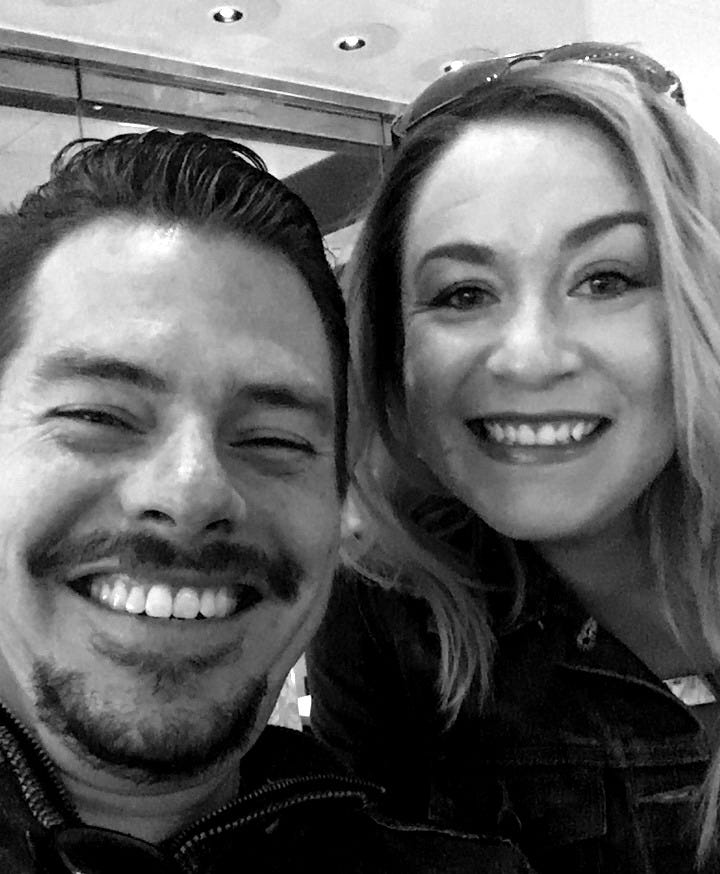
I want to make sure that I disclose the fact that I consulted for Sean back in 2019 and 2020. In my time working in this industry, he is one of the very few owners I have interacted with who legitimately listens to his team. He cares for his staff and he truly wants to see everyone succeed.
When I first started publishing these articles, Sean was one of the first people to reach out to me. His immediate reaction was not defensive or mocking, as many others were. Instead, he asked me,
“Have I ever been that boss?”
“Where have I fallen short?”
“How can we be doing better?”
The word “restaurant” comes from the word “to restore,” and a large portion of modern dining culture seems to have forgotten that.
It’s time to strip away the ego.
It’s time to stop making excuses for abuse and exploitation.
And it’s time to get back to what this industry is supposed to be.
The hospitality industry.
It’s hospitality, humility, empathy, respect, and sustainability… and sustainability starts with the people first, not the product.
And it starts with business owners like Sean. As he said, “It doesn’t cost anything to give a fuck.”